
By Sunday olatunji,Ado Ekiti .
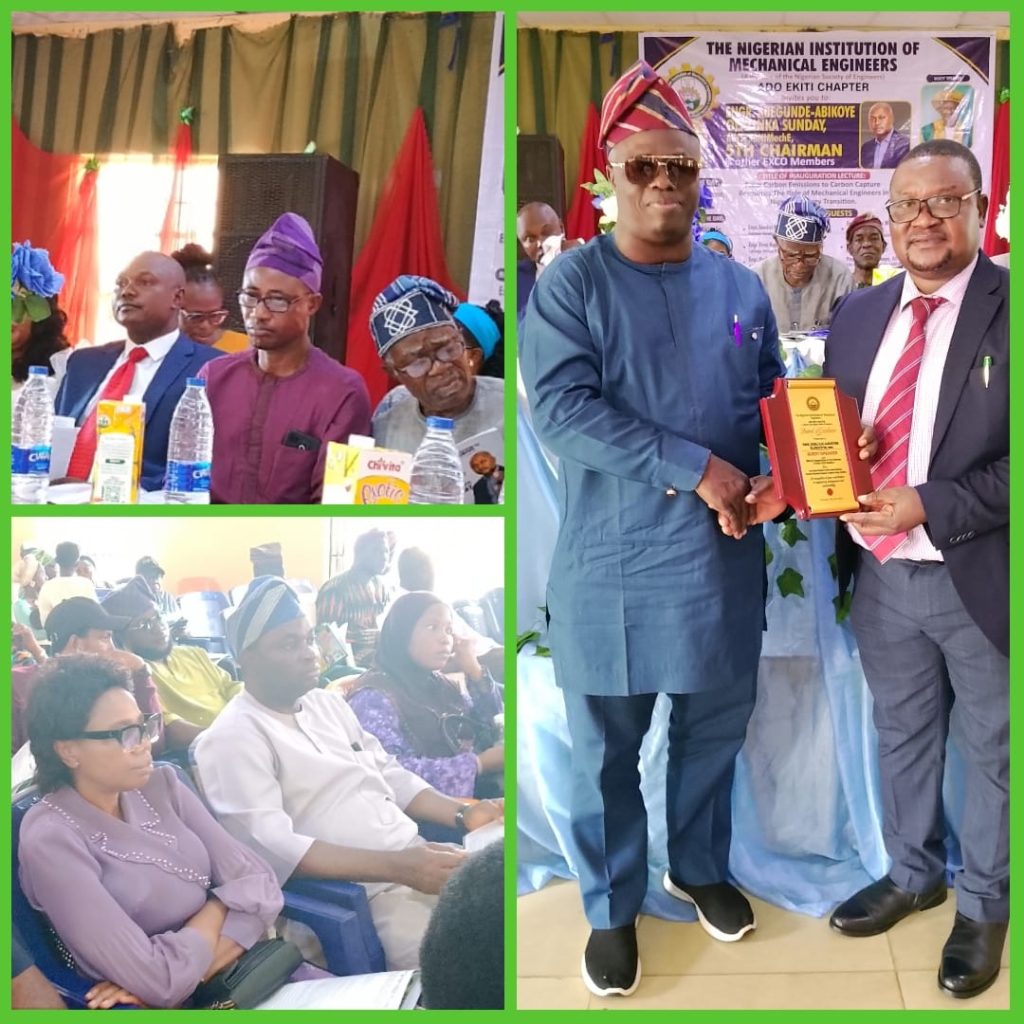
Energy expert and Chairman of Ado Central Local Council Development Area (LCDA), Ado Ekiti, Engr. Oluwatoyin Ojo, FNSE, has challenged mechanical engineers in Nigeria to develop innovative technologies that will transform carbon emissions from environmental waste into valuable resources capable of generating wealth and employment.
Ojo gave the charge on Tuesday at the Ekiti State Ministry of Works, Ajilosun, Ado Ekiti, while delivering a lecture as guest speaker at the inauguration and investiture of the 5th Chairman and Executive Council of the Nigeria Institution of Mechanical Engineers (NI MechE), Ado Ekiti Chapter.
Speaking on the theme, “From Carbon Emissions to Carbon Resources: The Roles of Mechanical Engineers in Nigeria’s Energy Transition,” Ojo identified oil and gas operations, transportation, open waste and refuse burning, and heavy industries as major sources of carbon emissions.
He noted that about 7.2 billion cubic metres of gas are flared annually, describing the practice as a huge waste of energy and a serious environmental challenge. He also noted that millions of households and businesses depend on generators, contributing significantly to fuel consumption and atmospheric pollution.
The energy expert stressed that carbon emissions contribute significantly to climate change, health problems, economic losses and climate-related financial risks. He, however, maintained that captured carbon could be converted into useful products such as fertiliser, cement, building materials, urea, methanol and polymers, thereby creating new industries and employment opportunities.
The guest speaker urged mechanical engineers to design more efficient machines and power systems, including improved turbines, heat exchangers and burners that can reduce fuel consumption, recover waste heat and minimise gas flaring.
He also called for rigorous research into Carbon Capture, Utilisation and Storage (CCUS), urging engineers to develop and manufacture CCUS components locally in order to reduce dependence on imported technologies.
To overcome the challenges associated with CCUS, which he described as capital-intensive, Ojo called for stronger government support, tax incentives, access to climate finance and increased industrial partnerships.
He further urged the Nigeria Society of Engineers (NSE) and the Council for the Regulation of Engineering in Nigeria (COREN) to strengthen training for engineers, technicians and regulators, while universities and polytechnics should introduce programmes in carbon capture, hydrogen technology and carbon markets.
Ojo said Nigeria’s energy transition should be viewed not only as an environmental necessity but also as an opportunity for engineers to create wealth, generate employment and contribute meaningfully to sustainable national development.
Commending Ojo for his contribution to the development of engineering and energy discourse, the National Chairman of the Nigeria Institution of Mechanical Engineers, Engr. Dr. Babagana Modu Tela, FNSE, FNIMechE, represented by Engr. Prof. T.O. Oni, FNSE; the Father of the Day, Engr. Prof. S.B. Adeyemo, FNSE; the outgoing Chairman of the Ekiti State Chapter, Engr. Dr. B.S. Oluwadare, FNIMechE, AMIMECH; and the newly inaugurated Chairman, Engr. Abegunde Abikoye Sunday, described his delivery of the lecture as brilliant, concise and easy to understand.
They described Ojo as a talented professional whose knowledge and wealth of experience are greatly needed in society, particularly in the academic community.
The engineers urged him to deploy his political influence and professional connections towards facilitating the conversion of research findings into practical solutions capable of addressing societal and national challenges.
The high point of the event was the presentation of an Award of Excellence in the Engineering Profession to Ojo by the Nigeria Institution of Mechanical Engineers in recognition of his contributions and professional accomplishments.
