
By Salami Abdulrahaman | Abuja
ABUJA – Stakeholders in Nigeria’s correctional system have called for stronger public-private partnerships (PPPs), expanded skills development and agricultural initiatives to support the rehabilitation and economic reintegration of inmates and former inmates.
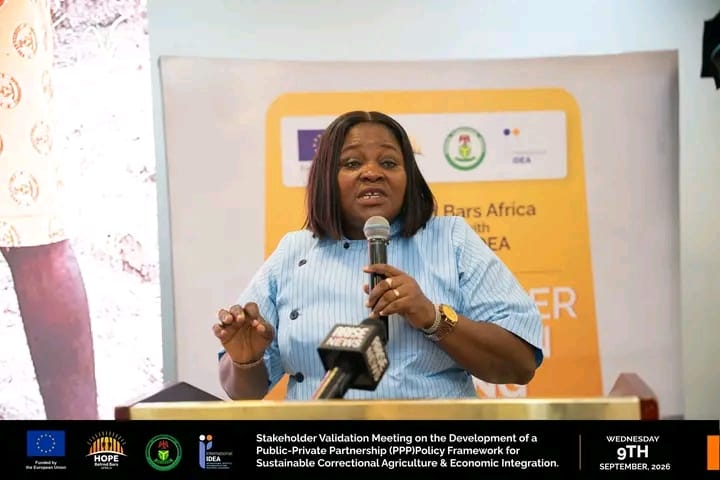
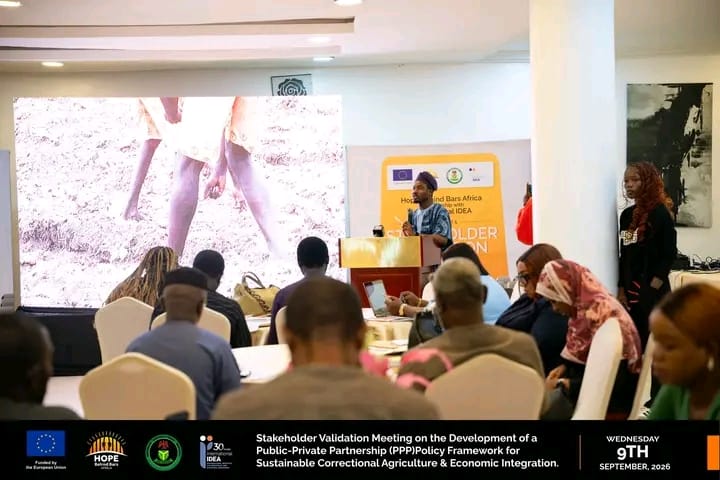
The call was made in Abuja during the validation of the Public-Private Partnership (PPP) Policy Framework for Sustainable Correctional Agriculture and Economic Reintegration. The exercise was organised to strengthen collaboration among the Nigerian Correctional Service (NCoS), civil society organisations, development partners and the private sector.
Speaking at the event, the Programmes Manager of Hope Behind Bars Africa, Nurudeen Hassan, emphasised the need for stronger representation and advocacy for people in correctional centres. He warned that neglecting inmates could create broader challenges for society.
Hassan said rehabilitation and reintegration should not be viewed solely as issues concerning prisoners but as essential components of building a safer, more inclusive and productive society.
«“If one person is left behind, then, in many ways, we are all left behind,” he said.»
He noted that many former inmates face stigma, exclusion and limited opportunities after their release, often leaving correctional facilities without the skills, support systems or economic opportunities required to rebuild their lives.
According to him, inadequate post-release support could increase the risk of reoffending.
Hassan recounted the case of a former inmate who was acquitted and released after spending more than seven years in custody but was reluctant to leave because he did not know where to begin rebuilding his life.
«“Imagine coming out after such a long period and discovering that the world has completely changed,” he said.»
He stressed the importance of equipping inmates with relevant skills and providing structured support to facilitate their successful transition back into society.
Hassan urged participants to critically review the draft policy and make recommendations that would ensure it was practical, sustainable and responsive to the realities of correctional agriculture and economic reintegration.
Also speaking, Oluwatoyin Badejogbin of the International Institute for Democracy and Electoral Assistance (International IDEA), under the Rule of Law and Anti-Corruption (RoLAC) Programme, described Nigeria’s transition from a punitive prison system towards correction, rehabilitation and reintegration as a significant reform.
He recalled that the Nigerian Correctional Service Act of 2019 introduced a broader approach to offender management, with greater emphasis on rehabilitation and reintegration.
Badejogbin said recidivism remained a major challenge, with many former inmates struggling with stigma, unemployment and inadequate post-release support.
«“Offenders can have a second chance when society creates the conditions to support that second chance,” he said.»
He highlighted success stories from Hope Behind Bars Africa, including former inmates who, after receiving support, established businesses and began assisting others leaving custody.
Badejogbin also emphasised the economic potential of correctional agriculture, noting that thousands of hectares of land under the control of the NCoS could be put to productive use through effective partnerships.
«“This is clearly not something the Correctional Service alone can do. It is not something government alone can do. It is something that all of us must collectively engage with,” he said.»
Representing the Controller-General of the NCoS, Assistant Controller Etuh Simeon Paul reaffirmed the Service’s commitment to developing a workable PPP framework for its farms and industries.
Paul said the validation exercise provided an opportunity for stakeholders to strengthen the draft policy and establish a clear framework for engagement with private-sector partners.
«“We are here to listen to your opinions and contributions, particularly on how this document can be strengthened and transformed into a practical and workable policy,” he said.»
He commended Hope Behind Bars Africa for its continued partnership, describing collaboration among stakeholders as essential to the success of the initiative.
Stakeholders said the validation exercise would generate recommendations aimed at strengthening the PPP policy and establishing a more sustainable model for correctional agriculture, skills development and economic empowerment.
They expressed optimism that the framework, once finalised and implemented, would provide inmates and former inmates with productive opportunities while contributing to food security, job creation and a more effective correctional system in Nigeria.
