
By Omotayo Peter Olatunde
Ekiti State University (EKSU), Ado-Ekiti, is steadily strengthening its position as one of Nigeria’s prominent institutions of higher learning, with remarkable strides in academic excellence, research, infrastructure, innovation, staff development and strategic partnerships.
Established on March 30, 1982, as Obafemi Awolowo University by the late Chief Michael Adekunle Ajasin, the first civilian governor of the old Ondo State, the institution has evolved over the years to become Ekiti State University, Ado-Ekiti.
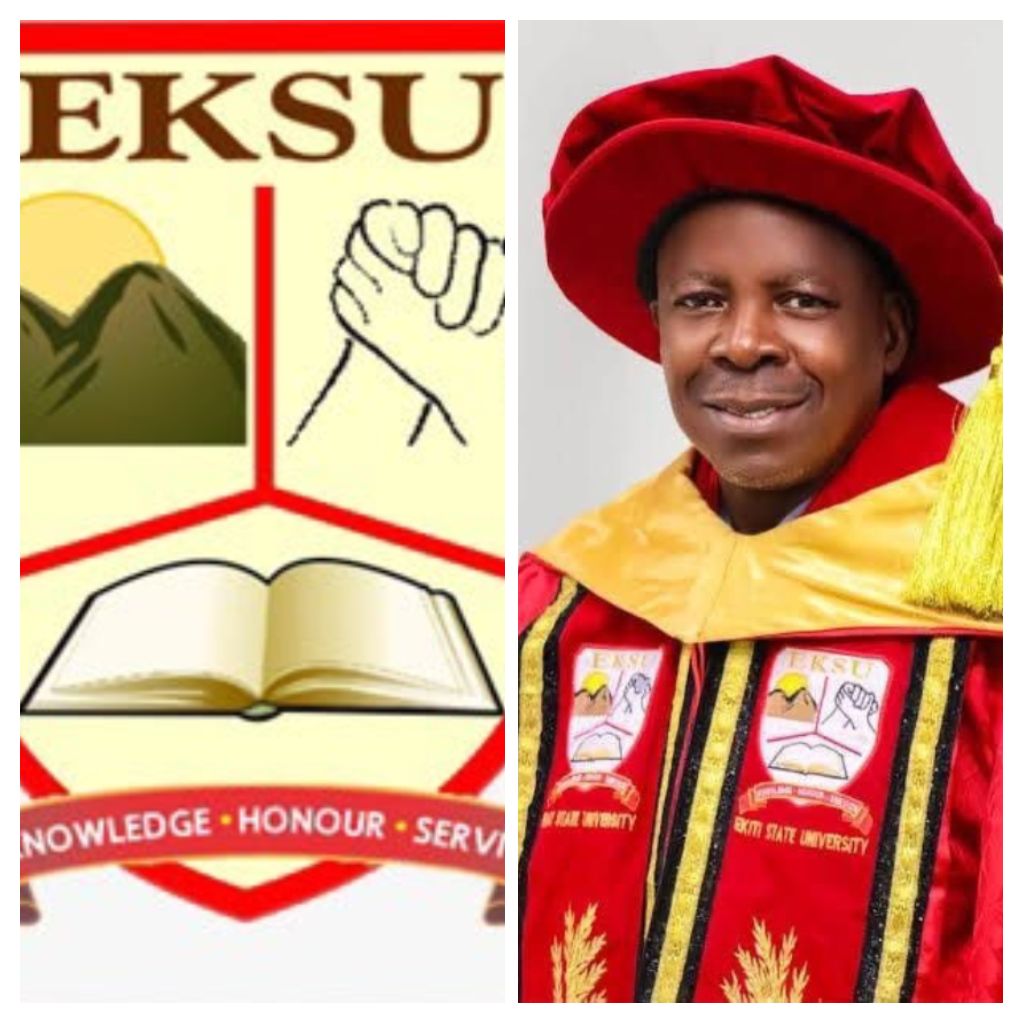
Successive administrations have contributed to the growth and development of the University, but the last two years under the leadership of Professor Joseph Babatola Ayodele, the ninth substantive Vice-Chancellor and the first alumnus of the university to occupy the position, have witnessed a notable period of institutional renewal and expansion.
Appointed by the Visitor to the University, His Excellency Biodun Abayomi Oyebanji, on August 20, 2024, Professor Ayodele assumed office, focusing on strengthening academic standards, improving staff welfare, expanding infrastructure, promoting research and innovation, and deepening strategic partnerships; the impact of which is increasingly visible across the University.
EKSU has expanded from 12 to 14 faculties, creating broader opportunities for specialised education, interdisciplinary learning and research. Programmes presented to the National Universities Commission for accreditation during the period recorded full accreditation, reflecting the University’s continued commitment to academic standards.
The University’s academic progress has also attracted external recognition.
Times Higher Education’s World University Rankings listed EKSU as Nigeria’s leading state university in its 2025 and 2026 editions. This recognition adds to the growing profile of an institution that continues to position itself within the competitive landscape of Nigerian higher education.
Student performance has equally remained an important measure of the University’s academic environment. In the 2026 Common Entrance Examination, all 21 candidates presented by the EKSU Staff School recorded impressive results, while the University’s College of Medicine recorded a 100 percent pass rate in the Professional Basic National Midwifery Examination, following a similar achievement in the previous year.
The approval for the commencement of postgraduate programmes in Medicine and Nursing represents another significant milestone, creating new opportunities for advanced professional training, specialized education and research.
Beyond academic programmes, the University has continued to place emphasis on staff welfare and career progression. The implementation of the Consolidated Academic and Associated Institutions Salary Structure (CONAAS) for academic staff, alongside approved adjustments relating to CONTISS and CONTAPS for non-academic staff, marked important developments in the University’s approach to staff welfare. The implementation of promotions for qualified staff has also provided opportunities for career advancement.
Infrastructure development has been another major feature of the University’s recent transformation.
EKSU has benefited significant interventions from the government, alumni, philanthropists and other stakeholders.
Among these are the lecture theatre donated to the Faculty of Law by the President of the Senate, Senator Godswill Akpabio, while the Faculty of Engineering alumni is developing a five-in-one lecture theatre. The Phase II project of the Faculty of Management Sciences, sponsored by Dr Zacch Adedeji, Executive Chairman of the Federal Inland Revenue Service, is also progressing.
The University’s alumni community has equally demonstrated its commitment to institutional development. Under the leadership of Ambassador Seyi Idowu, the EKSU Alumni Association donated office equipment valued at ₦23 million to support the upgrading of the Notifications and Certificates Division of the Registry.
The appointment of Dr Tunji Olowolafe as Chancellor further strengthens stakeholder support for the University. His interventions include two 500KVA transformers, 261 solar-powered streetlights and campus-wide Starlink Wi-Fi infrastructure.
These initiatives are contributing to improvements in power supply, campus illumination, connectivity and the general learning environment.
Technology and innovation have also assumed an increasingly important place in EKSU’s development agenda.
The EKSU ICT Experience Centre, donated by the First Lady of the Federal Republic of Nigeria, Senator Oluremi Tinubu, CON, through the facilitation of the wife of the Ekiti State Governor, Dr Olayemi Oyebanji, has significantly expanded the University’s capacity for computer-based examinations and other digital activities.
During the 2025/2026 academic session, the facility supported examinations conducted by EKSU and external bodies, including examinations relating to Nursing, JUBEB, TRCN and SUBEB recruitment. The University reported that these examinations were conducted seamlessly, with results released within 24 hours in the relevant exercises.
The National Automotive Design and Development Council’s CNG conversion and Electric Vehicle charging facility located on the campus further demonstrates EKSU’s growing interest in emerging technologies. The facility is designed to support training, research, innovation and knowledge transfer in clean-energy and automotive technologies.
The establishment of EKSU Radio 97.3 FM, through the support of Senator Opeyemi Bamidele, has also expanded the University’s communication reach. The station provides an avenue for the institution to showcase its academic programmes, research, innovations and achievements while strengthening engagement with the wider society.
In the health sciences, the University has continued to record significant milestones. All 38 EKSU students presented for the Professional Basic National Midwifery Examination in September 2026 passed the examination, giving the University another 100 per cent success rate. The Nursing and Midwifery Council of Nigeria also recognised the suitability of the University’s ICT Experience Centre for its Computer-Assisted Objective Structured Clinical Examination.
These achievements, together with approval for postgraduate programmes in Medicine and Nursing, further confirm EKSU’s position as an emerging centre for advanced professional education and research.
Professor Ayodele’s administration is particularly distinctive because of his deep personal connection with the institution. He is an alumnus who studied at EKSU, emerged as the University’s best overall student in 1992, joined the academic staff in 1995, rose through the academic ranks and eventually became Professor of Educational Management before attaining the University’s highest academic and administrative office.
His journey from student to lecturer, professor and Vice-Chancellor mirrors the evolution of the institution itself and provides a unique perspective on the University’s history, challenges and aspirations.
The story of EKSU today is therefore one of continuous transformation. Its expanding academic programmes, accreditation successes, student achievements, research and innovation initiatives, improved staff welfare, infrastructure development, technological investments, medical education milestones and growing stakeholder partnerships all point to an institution determined to strengthen its contribution to Nigeria’s educational development.
The University’s progress is not the achievement of one individual alone. It reflects the collective efforts of the Governing Council, management, academic and non-academic staff, students, alumni, government, development partners and other stakeholders who continue to contribute to the growth of the institution.
As EKSU looks towards the future, sustaining academic excellence, strengthening research, expanding infrastructure, promoting innovation and deepening partnerships will remain central to its continued development.
From its establishment in 1982 to its present identity as Ekiti State University, EKSU has continued to evolve with the changing demands of higher education.
Its recent achievements represent a significant chapter in that history one marked by academic excellence, institutional renewal, innovation, strategic partnerships and a growing reputation for distinction.
With the continued commitment of its leadership and stakeholders, Ekiti State University is not only preserving its proud heritage but also building an institution capable of making an enduring impact on generations of students, scholars and the wider society.
EKSU is, indeed, a pace-setting university advancing knowledge, nurturing talent and steadily writing a new chapter of academic distinction in Nigeria.
Omotayo Peter Omotayo is a Senior Information Officer in the Directorate of Information and Corporate Affairs,Ekiti State University (EKSU) Ado-Ekiti
