
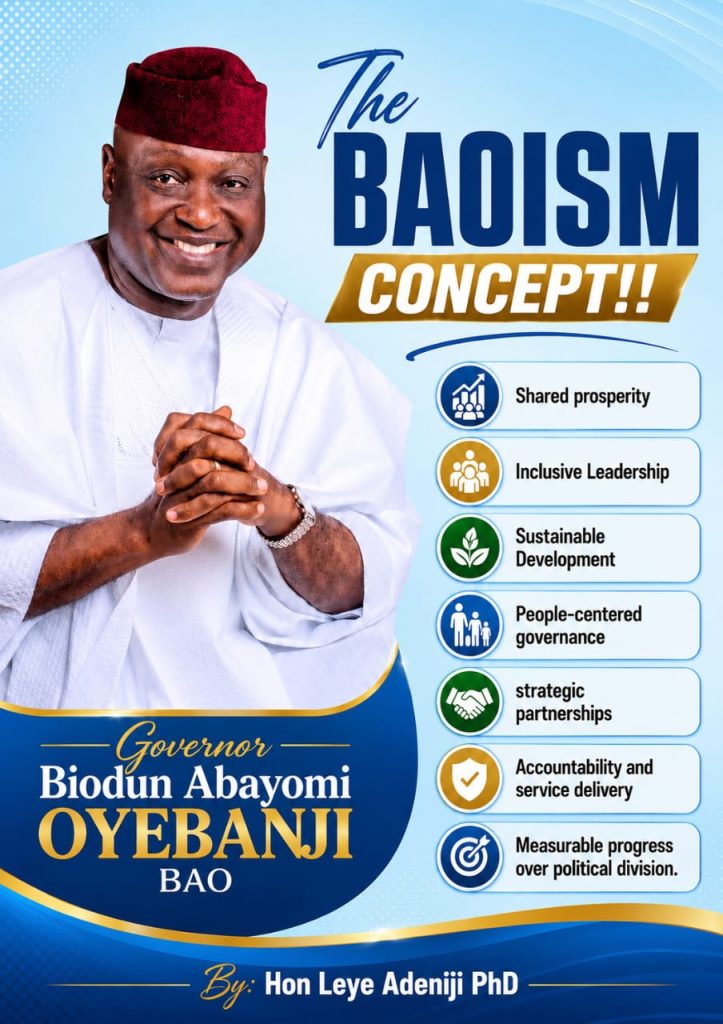
The BAOISM Concept represents a leadership philosophy that places the people at the heart of governance. It is built on the principles of inclusive leadership, where every stakeholder has a voice; shared prosperity, where the dividends of governance are extended to all; and sustainable development, where today’s progress lays a solid foundation for future generations.
BAOISM is an emerging political concept developed as a school of thought based on the political and governance style of Governor Biodun Abayomi Oyebanji BAO the Executive incumbent Governor of Ekiti state and the incoming Governor,the jinx breaker. It describes a style of governance rooted in the leadership philosophy associated with BAO. It emphasizes people-centered governance, inclusive leadership, continuity of development, strategic partnerships, and a commitment to sustainable progress.
At its core, BAOISM promotes:
Inclusive governance that carries every stakeholder along. Continuity over disruption, ensuring that development is sustained. Pragmatic leadership focused on solving real problems.
Unity and collaboration across political, religious, and social divides.
Accountability and service, placing the welfare of the people at the center of government. Shared prosperity, where the benefits of development are broadly distributed.
As a political school of thought, BAOISM can be viewed as an approach that prioritizes stability, consensus-building, institutional development, and measurable progress over political division.
Note that “BAOISM” is a coined political term rather than an established political ideology in political science just like:
Obafemi Awolowo – Awoism
Nnamdi Azikiwe – Zikism
The Great Aristotle – Aristotelianism
Plato – Platonism
Karl Marx – Marxism and many other great leaders whom their philosophies continue to influence leadership, governance, public policy, and national development in different parts of the world.
For educational and academic research purposes, let me say it that for now If you use BAOISM in publications or speeches, it is best presented as a concept or philosophy associated with BAO’s style of leadership rather than as a formally recognized school of political thought.
