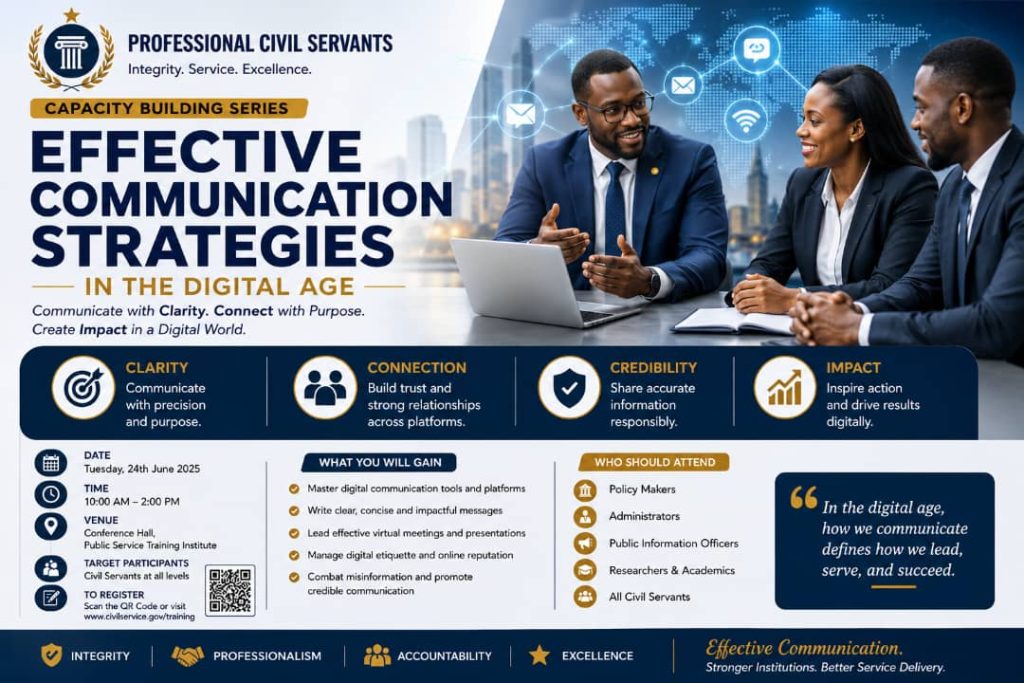
Effective Communication Strategies in the Digital Age: A Strategic Imperative for the Civil Service and Academic Community
By::Ola Asubiojo Communication has always been the lifeblood of human interaction, but in the digital age it has become the heartbeat of institutional effectiveness. We now live in an era where a message can traverse continents in seconds, decisions are influenced by digital conversations, and reputations are built—or damaged—by the quality of communication.
Consequently, effective communication is no longer an optional professional skill; it is a strategic necessity for excellence in governance, administration, and academia.
The civil service thrives on communication.
Policies are conceived through dialogue, refined through consultation, and implemented through clear directives. Every circular, memorandum, report, email, and official briefing contributes to the quality of public service delivery.
When communication is timely, accurate, respectful, and transparent, institutions earn public trust, productivity improves, and government becomes more responsive to the needs of the people.
Conversely, vague instructions, delayed responses, misinformation, and poor feedback mechanisms often breed inefficiency, conflict, and administrative setbacks.
Similarly, the academic world flourishes where ideas are communicated with clarity, rigour, and intellectual honesty. Teaching, research, mentorship, scholarly publications, and interdisciplinary collaborations all depend on effective communication.
A brilliant idea poorly communicated may never influence society, while a well-presented idea has the capacity to transform institutions, shape public policy, and advance human knowledge.
The digital revolution has undoubtedly expanded opportunities for communication through emails, virtual meetings, social media platforms, cloud-based collaboration, and artificial intelligence.
Yet, these innovations also present significant challenges. Information overload, fake news, cyber misinformation, careless online expressions, emotional reactions, and the misuse of digital platforms have become common threats to professional credibility. In many organisations, communication fails not because technology is absent, but because wisdom, discipline, empathy, and professionalism are lacking.
An effective communicator in the digital age must therefore cultivate more than technical competence.
Clarity of expression, active listening, emotional intelligence, critical thinking, digital etiquette, confidentiality, respect for institutional hierarchy, and cultural sensitivity have become indispensable qualities. Every digital interaction should reflect accuracy, courtesy, accountability, and ethical responsibility.
Communication should enlighten rather than confuse, reconcile rather than divide, and inspire confidence rather than uncertainty.
One of the greatest communication failures in both the civil service and academia is the assumption that transmitting information is equivalent to achieving understanding.
Genuine communication is complete only when the intended message is accurately received, correctly interpreted, and translated into meaningful action.
This requires continuous feedback, openness to diverse perspectives, and a commitment to mutual understanding rather than mere expression.
Great institutions are built by great communicators.
History consistently demonstrates that visionary leaders are remembered not only for the policies they introduced or the discoveries they made, but also for their ability to communicate vision with clarity, courage, compassion, and conviction.
Their words inspired confidence, mobilised collective action, and transformed aspirations into measurable achievements.
As digital technologies continue to reshape governance and education, the demand for strategic communication will only become greater.
The future belongs to institutions that communicate with transparency, innovate with responsibility, and engage people with authenticity
. The civil servant who communicates effectively strengthens public confidence.
The academic who communicates effectively expands the frontiers of knowledge. Together, they become architects of national development and custodians of societal progress.
Ultimately, effective communication is more than the exchange of information; it is the intelligent transmission of ideas, values, and purpose.
It is the bridge that connects leadership with followership, policy with implementation, knowledge with innovation, and vision with reality.
In the digital age, where every word has the power to influence countless lives, communicating effectively is not merely a professional obligation—it is a defining mark of responsible leadership and enduring excellence.