
Multi-purpose facility to boost engineering training, research and automotive innovation in Ekiti and South-West Nigeria
The Vice-Chancellor of Ekiti State University (EKSU), Ado-Ekiti, Professor Joseph Babatola Ayodele, has described the newly established Compressed Natural Gas (CNG) and Electric Vehicle (EV) Centre at the university as a landmark project that will position EKSU at the forefront of Nigeria’s renewable energy revolution.
Professor Ayodele made the remark while receiving the Director-General of the National Automotive Design and Development Council (NADDC), Otunba Oluwemimo Osanipin, during a courtesy visit and inspection tour of the facility ahead of its official commissioning.
The Vice-Chancellor said the centre is more than a vehicle charging and conversion station, explaining that, it has been designed as a practical training and research facility that will equip students with industry-relevant skills, while promoting cutting-edge research in renewable energy and automotive technology.
According to him, the project aligns with the university’s vision of producing graduates capable of competing globally in emerging technologies.
“This partnership is a noble one, and I will continue to do everything possible to collaborate with reputable organisations and institutions to further enhance the development of Ekiti State University,” Professor Ayodele said.
He noted that the facility would enable EKSU to compete favourably with leading universities across Nigeria and internationally, particularly in advanced automotive technology and renewable energy research.
The Vice-Chancellor commended the contractors, consultants, site engineers and all stakeholders whose commitment ensured the timely completion of the project.
He used the occasion to reaffirm the university’s commitment to ensuring that the CNG-EV Centre is fully utilised for teaching, research, innovation and practical student training.
In his remarks, the Director-General of NADDC, Otunba Oluwemimo Osanipin, described the collaboration with EKSU as a strategic initiative aimed at bridging the long-existing gap between academia and industry.
Osanipin stressed that meaningful national development cannot be achieved when universities, policymakers and the organised private sector operate independent of one another.
“We’ve noticed that even the organised private sector is not adequately financing research, nor are they utilising many of the research outcomes from our universities. That gap must be bridged,” he stated.
He expressed confidence that the partnership with EKSU would promote innovation, technology transfer and manpower development for Nigeria’s automotive sector.
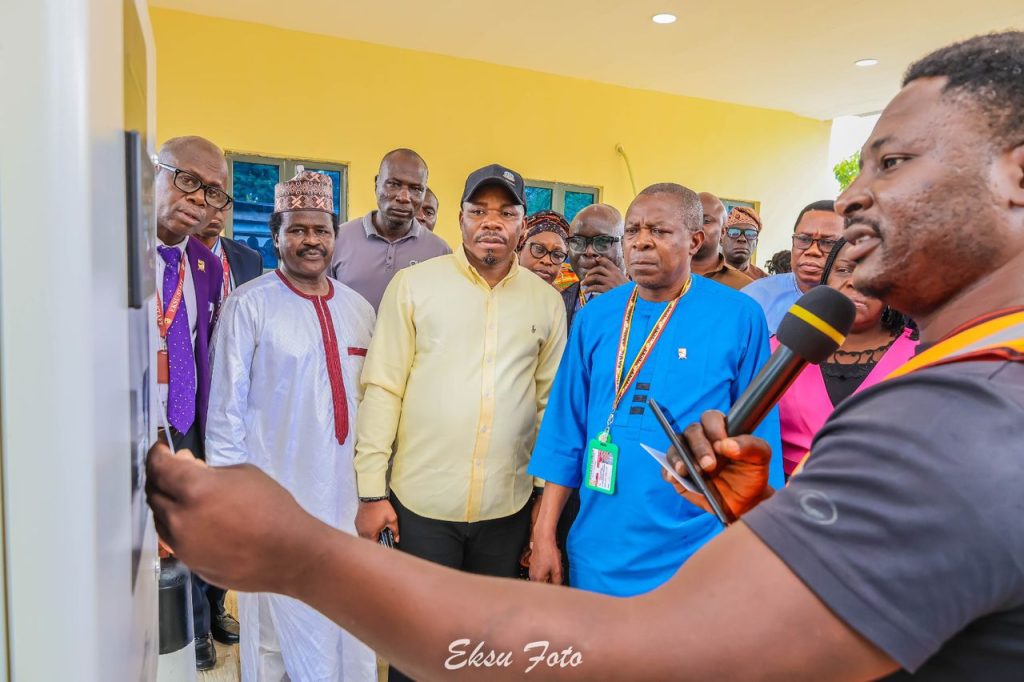
Following the meeting, the Vice-Chancellor led principal officers of the university and the NADDC delegation on an extensive inspection of the completed facility ahead of its commissioning.
Speaking with journalists after the tour, the Site Engineer, Emmanuel Joseph, explained that the centre features a modern electric vehicle charging station equipped with two dispensing units.
“One of the units has two charging guns capable of delivering 30 kilowatts per gun, allowing two electric vehicles to be charged simultaneously” he said.
He disclosed that the facility also provides CNG vehicle conversion services, noting that although the technology has existed for years, it is now gaining widespread acceptance because of its affordability, efficiency and environmental benefits.
According to him, an electric vehicle with between 20 and 30 per cent battery capacity can be fully charged within 30 to 40 minutes, while CNG-powered vehicles offer greater fuel efficiency and longer travel distances compared to conventional petrol vehicles.
Joseph explained further, that the centre is primarily designed as a training and innovation hub where students will acquire practical knowledge on electric mobility, CNG technology and the transition from fossil fuels to cleaner energy sources.
He added that the facility will also operate a mobile charging service, enabling emergency support for electric vehicle users who become stranded due to low battery power.
“If anyone gets stranded because the battery runs out, we will be able to dispatch our mobile charging unit from this centre to provide assistance,” he said.
The CNG-EV Centre is expected to serve as a model for universities across Nigeria, supporting the country’s transition to cleaner, more sustainable energy solutions while strengthening research, innovation and workforce development in the automotive sector.
The courtesy visit and inspection tour was well attended by the principal officers and other officers of the University.
